
What Counts as a Qualified Call? Google Ads Conversion Tracking for Contractors

A qualified call is a real person asking for a job you do, in an area you serve, judged by what was said, not how long it lasted. One Chicago water heater shop spent $7,365 on Google Ads one summer, and Google counted 44 conversions. When we listened, 20 were people asking for work.
Below are the six filters every call goes through, how qualified calls get back into Google Ads, and which sources send real ones. The numbers come from plumbing and HVAC accounts we run in Chicago, unnamed.
QUICK FACTS
What the reader came for
Count callers who asked for work, not call length
A real number from our accounts
20 of 44 (June to August 2026)
What it costs
$167 to $368 cost per lead, depending on what you count
How long it takes
30 qualified leads or 90 days to switch bidding
Who it’s for
Contractors in any trade who run ads
Questions About Your Own Account?
15 minutes with the people who wrote this. Bring your last report.
Why Doesn’t Google’s Conversion Count Match Your Phone?
Because Google counts whatever you told it to count, and most accounts tell it to count everything. A three second hang up, a robocall and a form submission full of gibberish land in the same column as a homeowner standing next to a leaking tank.
That’s the gap Google Ads conversion tracking for contractors has to close. A two-man water heater shop in Chicago spent $7,365 on ads from June through August 2026, and Google reported 44 conversions.
Our tracking logged 44 calls and forms from the ads, and when we listened to every one, 20 were people asking for water heater work.
So the dashboard said 44 leads at $167 each. The real number was 20 quotable calls at $368 each. Same ad spend, very different business decision.
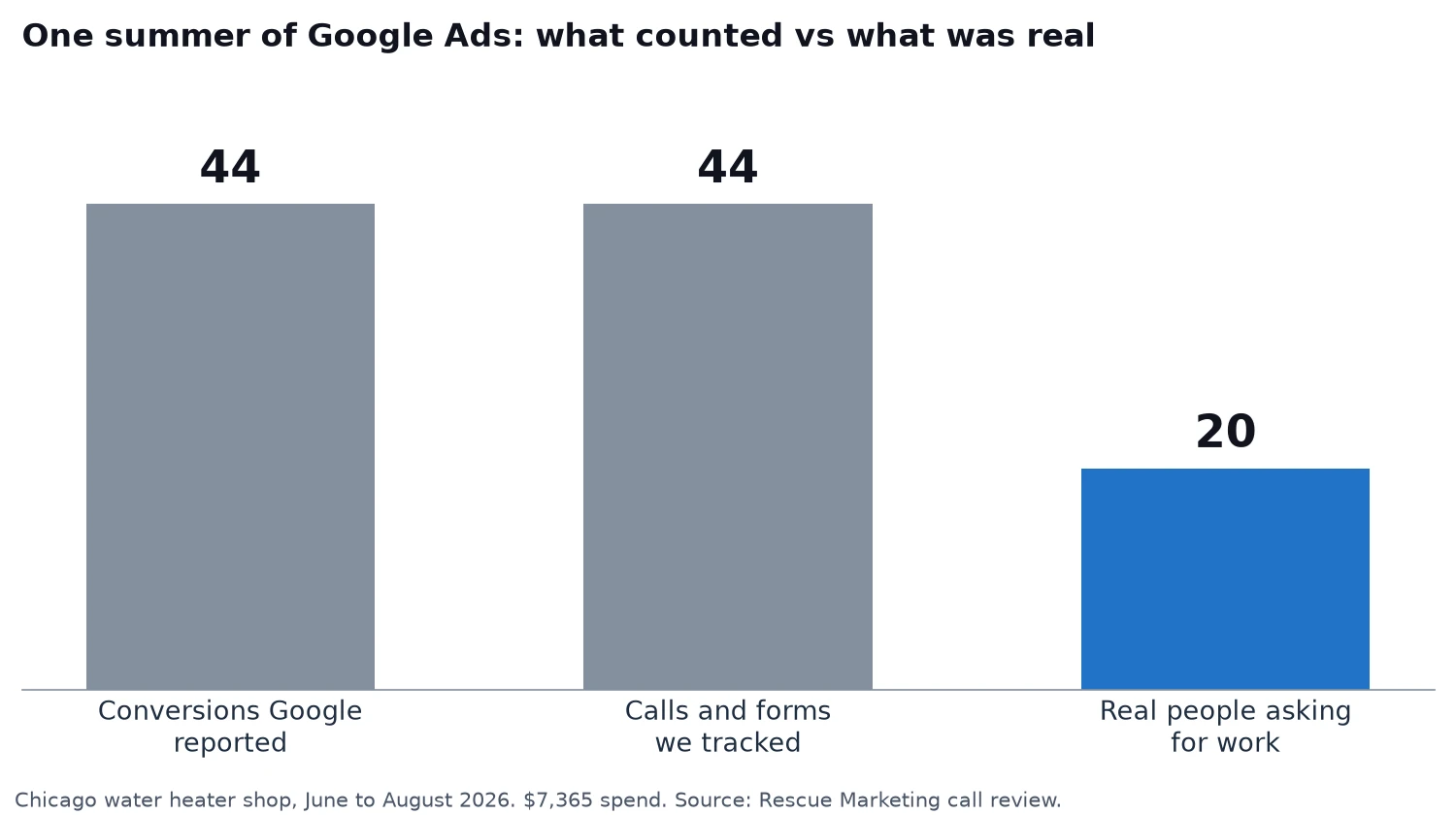
Google reported 44 conversions; 20 were real people asking for work. Chicago water heater shop, June to August 2026.
Robocalls make it worse. One Google listing for a Chicago HVAC company logged 81 tracked calls between June and September. Six were real customers.
If your clicks aren’t turning into calls at all, that’s a different problem, and the fix starts with your search terms and your budget.
What Is a Qualified Call?
A qualified call is one that gets through six filters, in order, before it counts. Every call and form runs through the same six:
- The same caller twice is one lead, not two.
- Our own test calls never count.
- Wrong numbers and people looking for another business.
- Hang ups and calls where nobody talked about a job.
- Callers outside your service area. When in doubt, it stays in.
- Services you don’t offer.
Every call and form still shows on your report, so you see everything that came in. Only the ones that qualify count. That’s the number we judge the marketing by.
Does Call Length Matter?
No. A 30 second call can be your best lead of the week.
Some of the sharpest shops we work with ask every caller for a photo of the unit and the serial number. Those calls often run 20 to 45 seconds. Once a homeowner has walked to the basement and sent that photo, they’re invested, and they usually book.
Most setups with a minimum call duration would throw that call out.
The common advice is to count a call only after 60 or 90 seconds. Google’s call conversion action was built the same way, with a 60 second default.
Google now offers AI-qualified call leads, which listen to recorded calls and count only the ones that sound like a lead. When a call can’t be recorded, Google falls back to call length. Our gate still checks every call against your service area and the services you offer.
A long call can be a vendor pitch. A short one can be your next replacement job.
So we judge what was said, not how long it took.
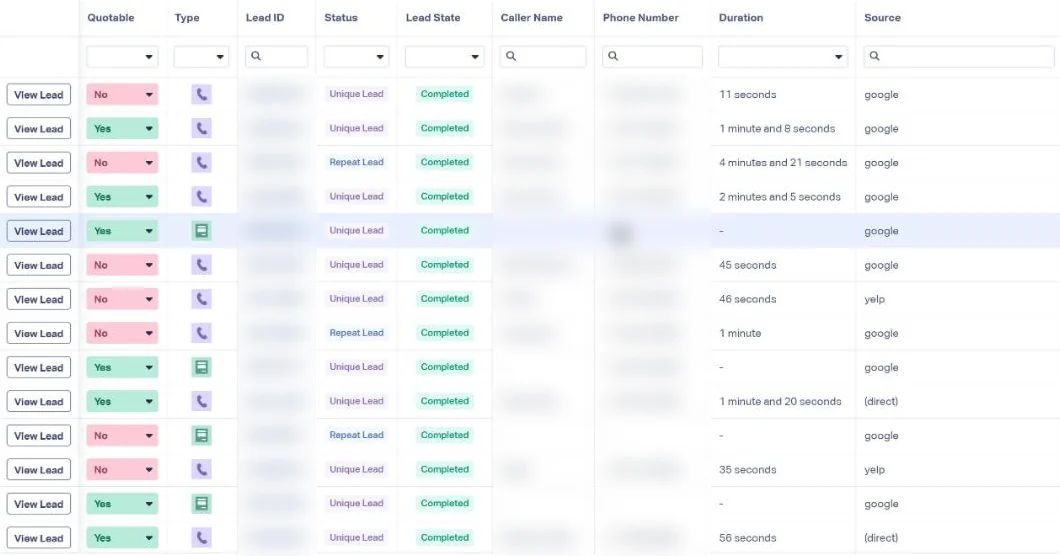
Real lead log, August 2026: a 56 second call marked quotable, while 4 minute and 1 minute repeat calls were not. Caller details blurred.
Who Decides Whether a Call Counts?
A person on our team reviews every call and form before it counts, and when your CRM is connected, a booking marks it for us.
A timer can’t tell a homeowner from a robocall. A person can.
Across home services, 52% of calls reach a person, and 38% of those answered calls are leads (Invoca, 2026, from a dataset of 70M+ calls). The rest still land in Google’s conversion column unless someone sorts them.
At that HVAC company, robocalls were 14 of 25 calls one March. The month before, all 10 form fills were junk.
That review is the gate for lead quality. No data goes back to Google Ads until the call passes.
How Do Qualified Calls Get Back Into Google Ads?
Each qualified call goes back to Google Ads as a conversion, tied to the click that started it, so Google learns to find more callers like it.
Here’s how that works without the jargon. When someone clicks your ad, the click carries a tag called a GCLID, Google’s click ID, which ties it to whatever happens next.
Google Tag Manager holds the tracking code on your site, so the call or form keeps that tag. When a call passes the gate, an offline conversion import sends it back to Google Ads, matched to the original click, so the attribution holds.
Enhanced conversions for leads is a backup match. It uses the caller’s hashed phone number or email to find the click when the tag gets lost.
Smart bidding, the automated bidding strategies inside your account, takes it from there and adjusts your bids to find more people like that caller. Feed it junk conversion data and it finds you more junk. Feed it qualified calls and it learns what a real customer looks like, which is the only honest way to optimize a contractor account.
We run this on WhatConverts, the call tracking platform we use on client accounts. Disclosure: we’re a WhatConverts affiliate and earn a commission if you sign up.
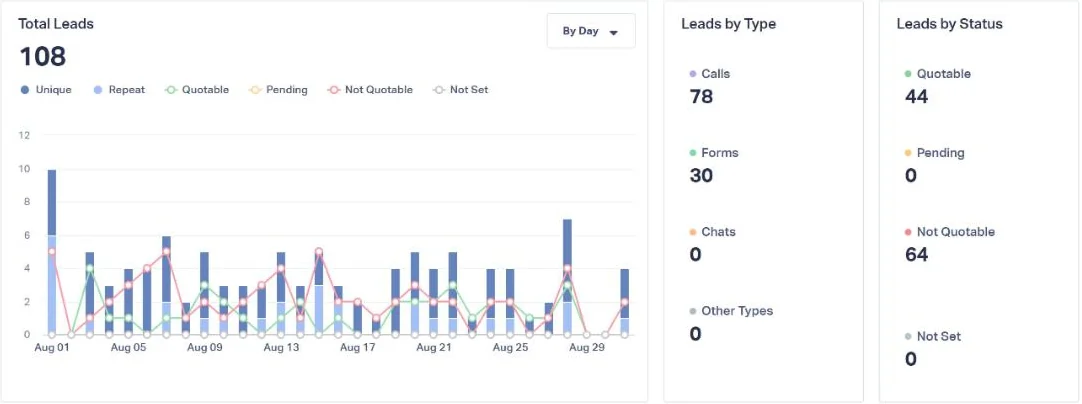
August 2026 in one account: 108 calls and forms, 44 marked quotable and 64 not.
Start with calls and forms
When you first set up conversion tracking, a brand new account can’t bid on qualified calls yet. Google needs volume to learn, and a new account doesn’t have it.
So a new account bids on every call and form at first, each set up as its own conversion action. The gate still judges every call from day one, and the qualified ones pile up in the background. At 30 qualified leads or 90 days, whichever comes first, Google switches to bidding on qualified leads only.
| What Google counts | When Google bids on it |
|---|---|
| All Calls | From day one until the switch |
| All Forms | From day one until the switch |
| Qualified Lead | After 30 qualified leads or 90 days |
| Booked Job | Once your CRM is connected, with the job’s dollar value as the conversion value |
Qualified leads and booked jobs are the numbers that pay, and cost per booked job is the one to watch. Calls and forms are how a new account gets there.
The fix: once you hit 30 qualified leads or 90 days, make Qualified Lead the conversion action Google optimizes toward. Keep All Calls and All Forms in your reports so you still see every call and form.
Which Lead Sources Send the Most Qualified Calls?
In one Chicago water heater shop’s numbers, organic search sent the highest share of real calls and Yelp sent the lowest.
| Source, June to September 2026 | Qualified | Rate |
|---|---|---|
| Google organic | 71 of 143 | 50% |
| Google Ads | 23 of 53 | 43% |
| Yelp calls | 30 of 140 | 21% |
Count raw calls and Yelp looks almost as big as organic search. Run the same calls through the gate and Yelp sends about one real call in five. Organic sends one in two.
Without the gate, you’d fund the wrong channel.
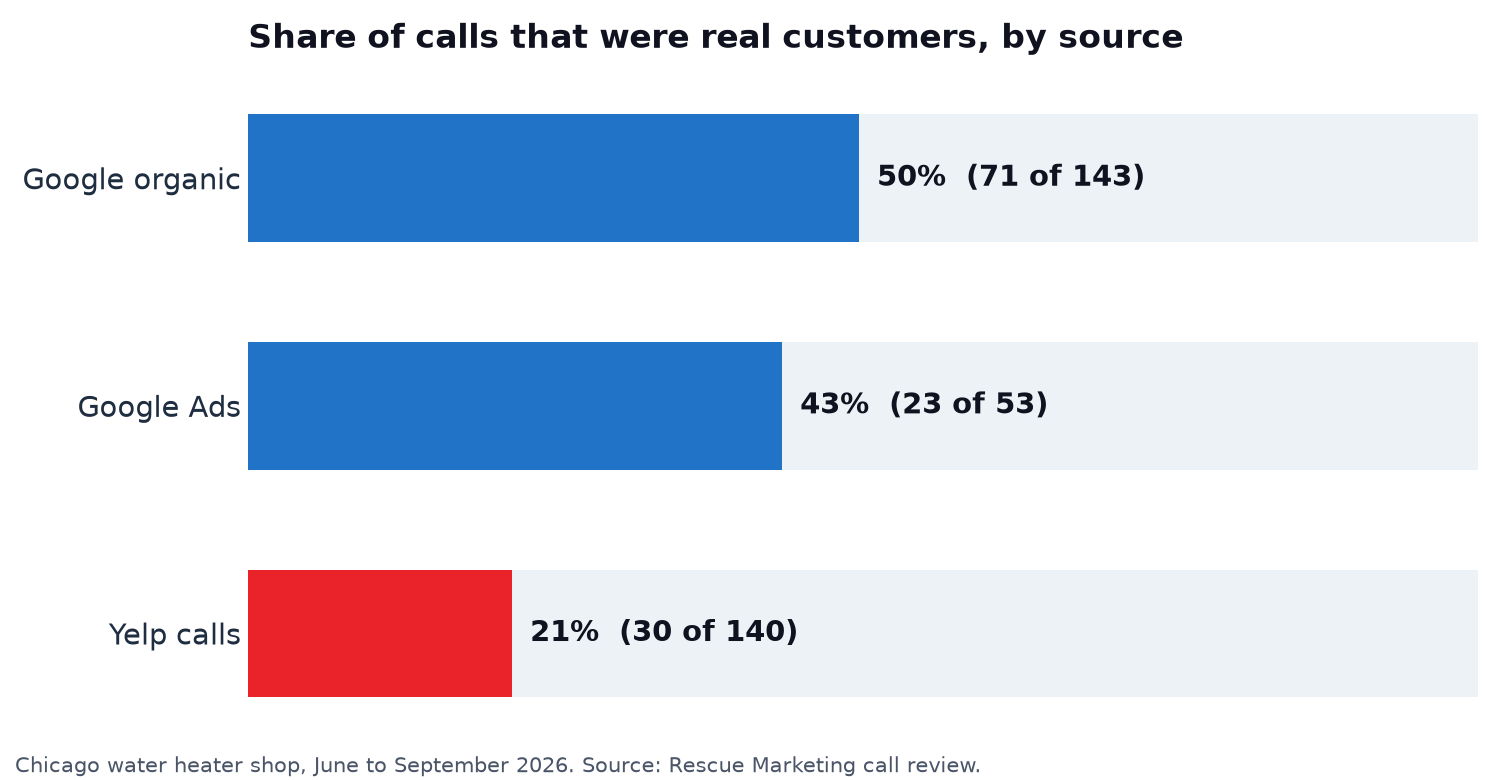
Share of calls that were real customers by source: organic 50%, Google Ads 43%, Yelp 21%. June to September 2026.
Does This Work in Every State?
Yes. The gate works the same in every state, but the rules for recording the calls you review don’t. Judging a call means hearing it, and that usually means recording it.
| State | Who has to agree to a recording | The rule |
|---|---|---|
| Illinois | Everyone on the call | 720 ILCS 5/14-2 |
| California | Everyone on the call | Penal Code 632 |
| Texas | One person on the call | Penal Code 16.02 |
Heads up: Google now records ad calls by default in the US and Canada. In Illinois and California, everyone on the call has to agree to that recording.
Add a short recording notice at the start of every call. Then check your own state’s rule before you rely on recording.
What changes from market to market is the mix: how many robocalls, how many wrong numbers, how many real jobs. That’s why we judge your calls, not a national average.
What Should Google Count?
Count what you’d count on the job: real people, asking for work you do, where you do it. On an inspection, if you didn’t write it down, it didn’t happen. Calls work the same way.
Running Google Ads for contractors works when Google learns from real jobs. A call nobody judged is a guess.
Google can’t learn from a guess.
Frequently Asked Questions
Find out how many of your leads were real. We’ll go through your call log and what your Google Ads account counts, and show you the gap.
Sources
- Invoca, The Invoca Home Services Lead Conversion Benchmarks Report 2026, published July 2026, checked October 21, 2026
- Google Ads Help, Measure calls from ads, checked October 21, 2026
- Google Ads API, Conversion action categories, checked October 21, 2026
- Google Ads Help, About AI-qualified call leads, checked October 21, 2026
- Illinois General Assembly, 720 ILCS 5/14-2, checked October 21, 2026
- California Legislative Information, Penal Code 632, checked October 21, 2026
- Texas Legislature, Penal Code 16.02, checked October 21, 2026
- Google Business Profile Help, Add your phone number, checked October 21, 2026
- Rescue call tracking and ad account data, two client accounts, February to September 2026 (accounts unnamed)
KEEP READING
THE SERVICE BEHIND THIS GUIDE
Marketing Analytics
Every call tracked, judged against the gate, and reported by where it came from, in a tracking login that’s in your name.
FREE AI VISIBILITY AUDIT
Book Now To Get Your Phone Ringing & Schedule Fully Booked
A $497 audit, free. We check your phone, your rankings, your AI visibility and your tracking, then give you one number: what you are leaking a month.